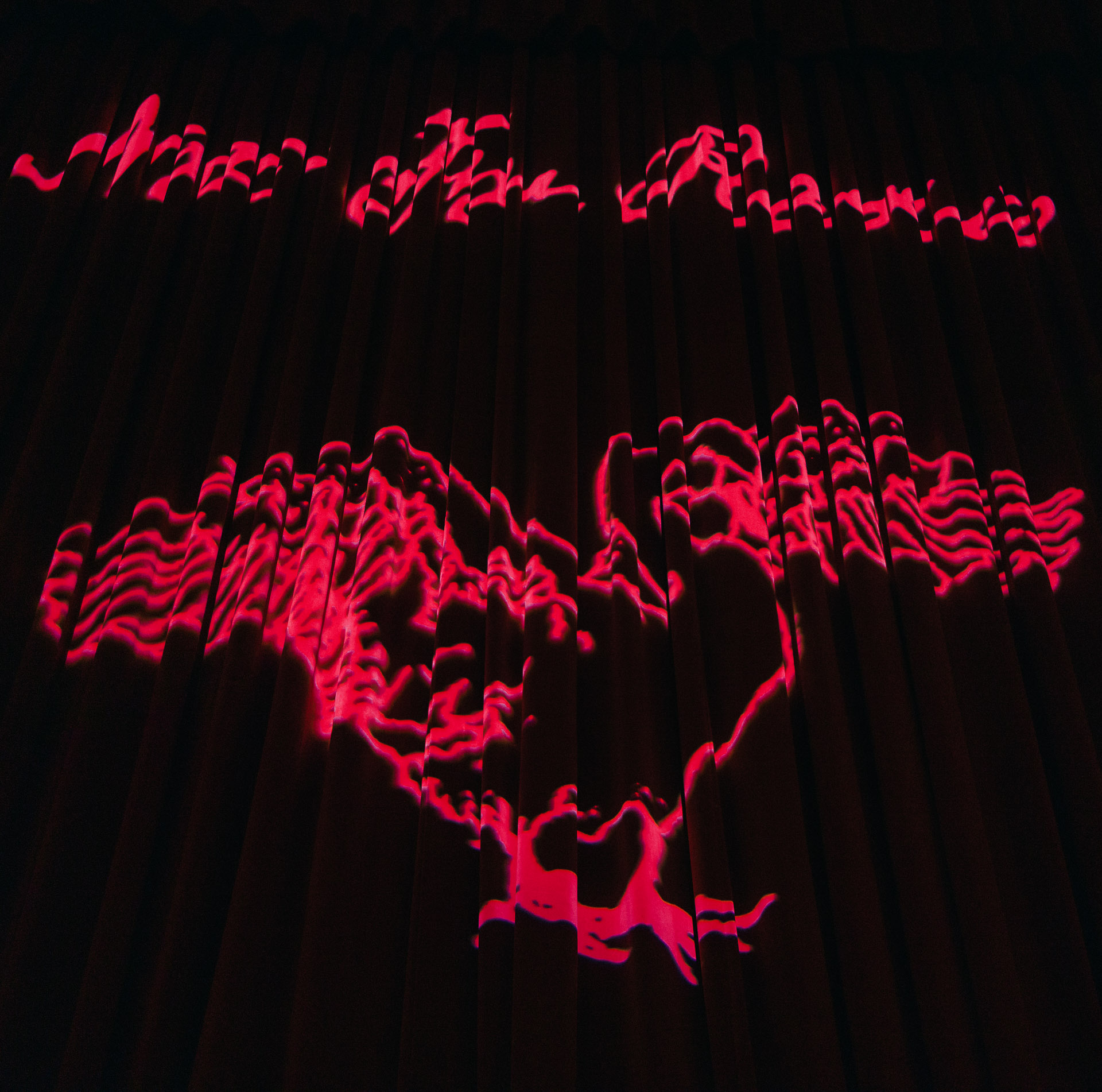
Suit Aesthetics and Open Tunings: Getting to Know April Company
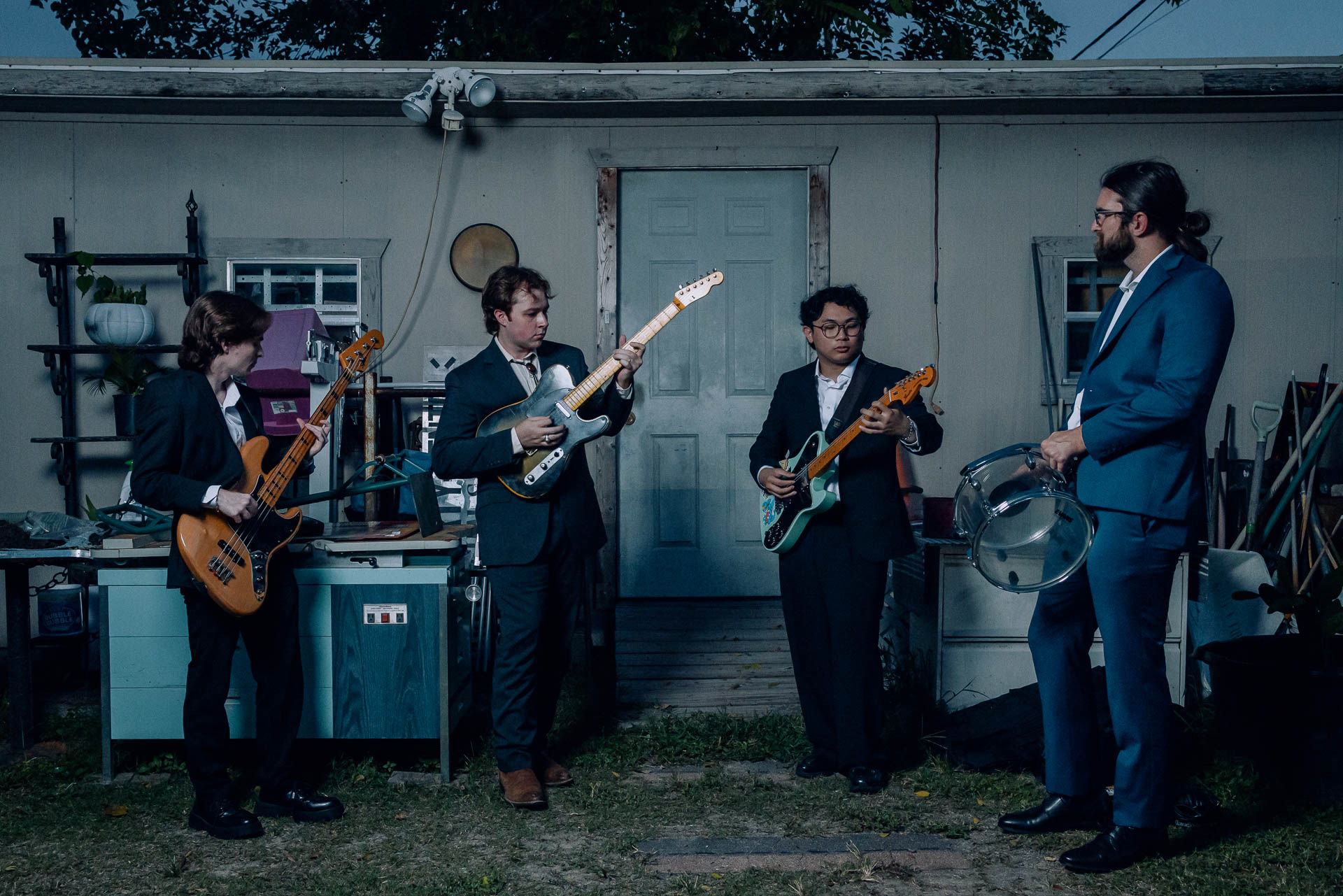
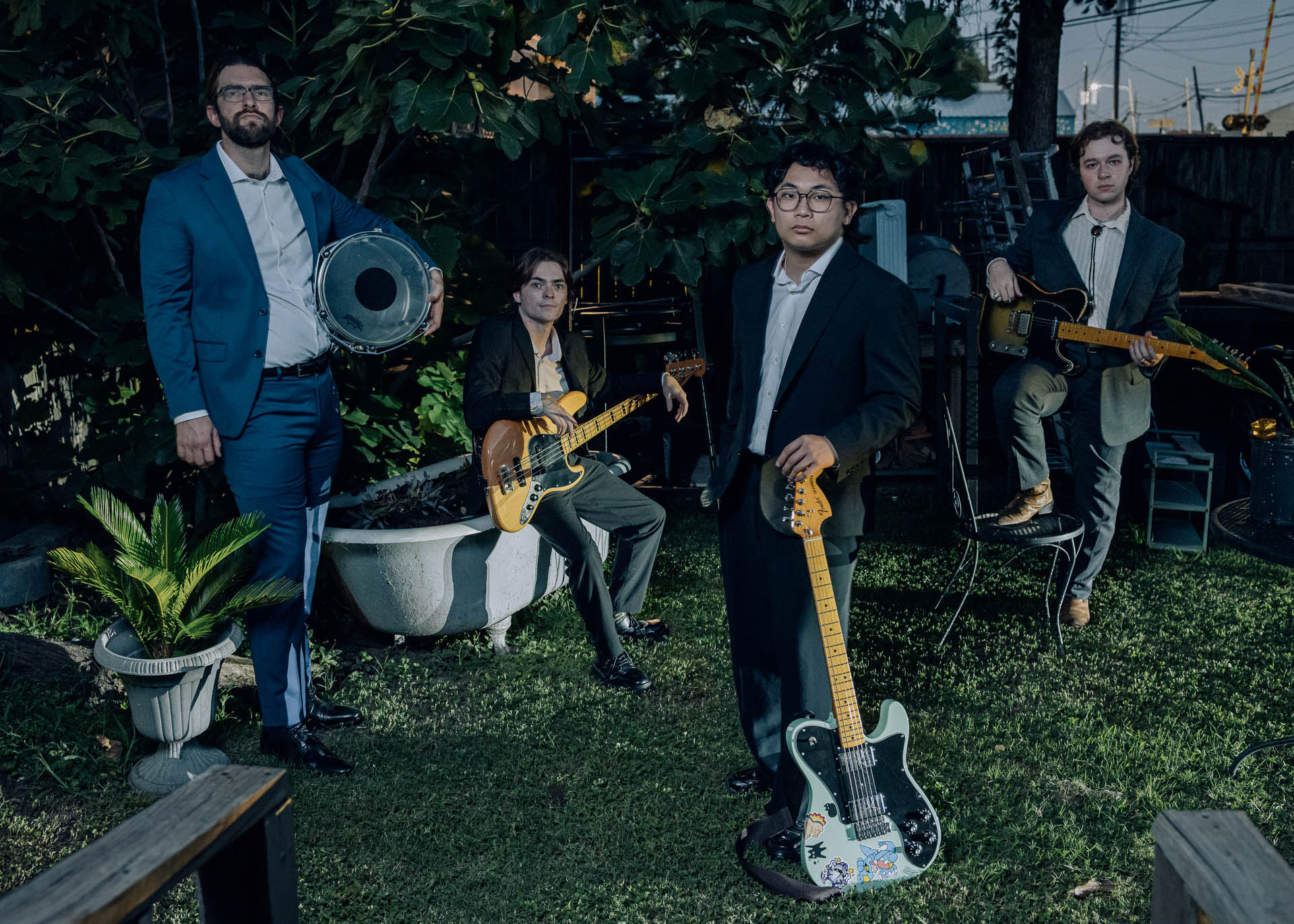
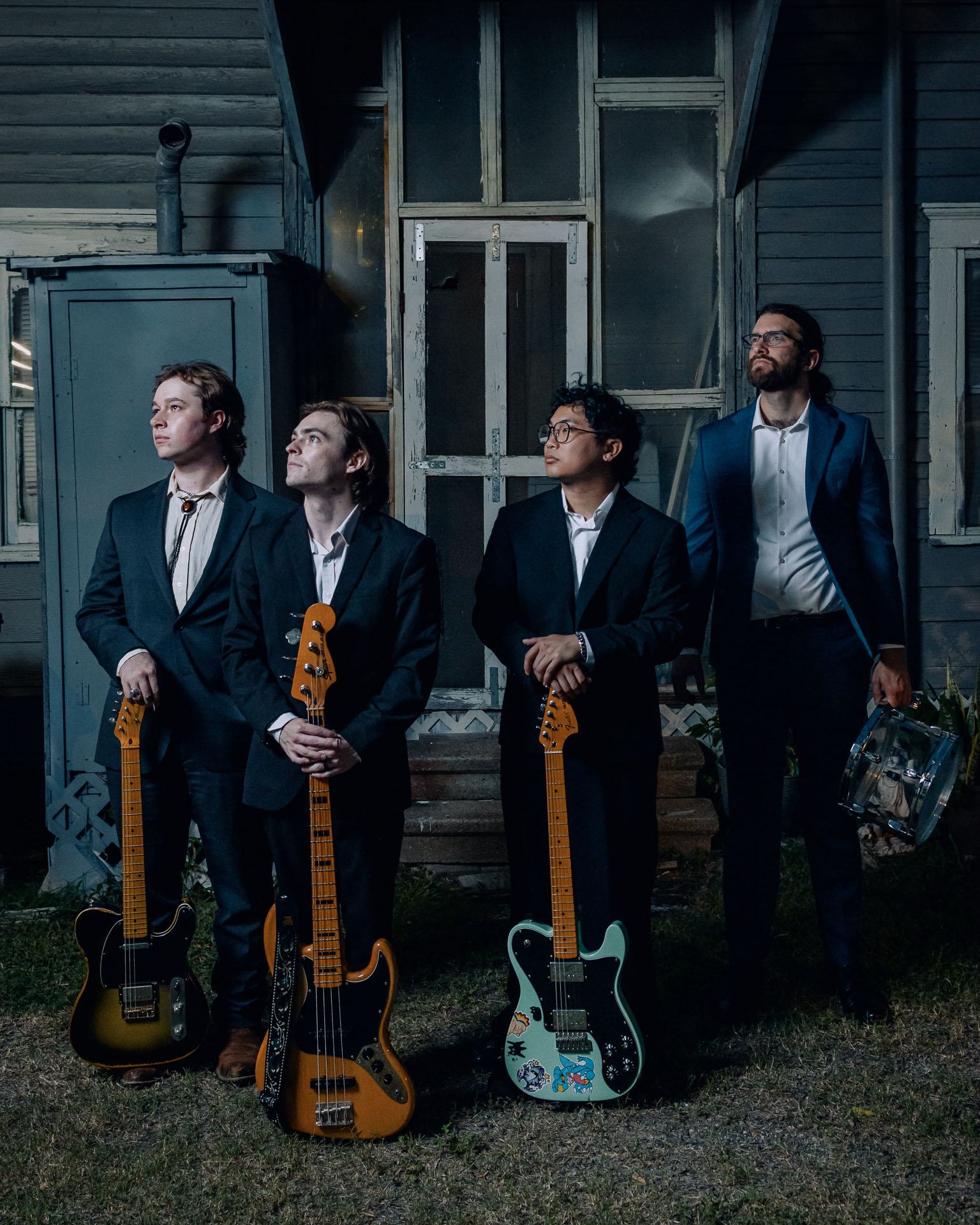
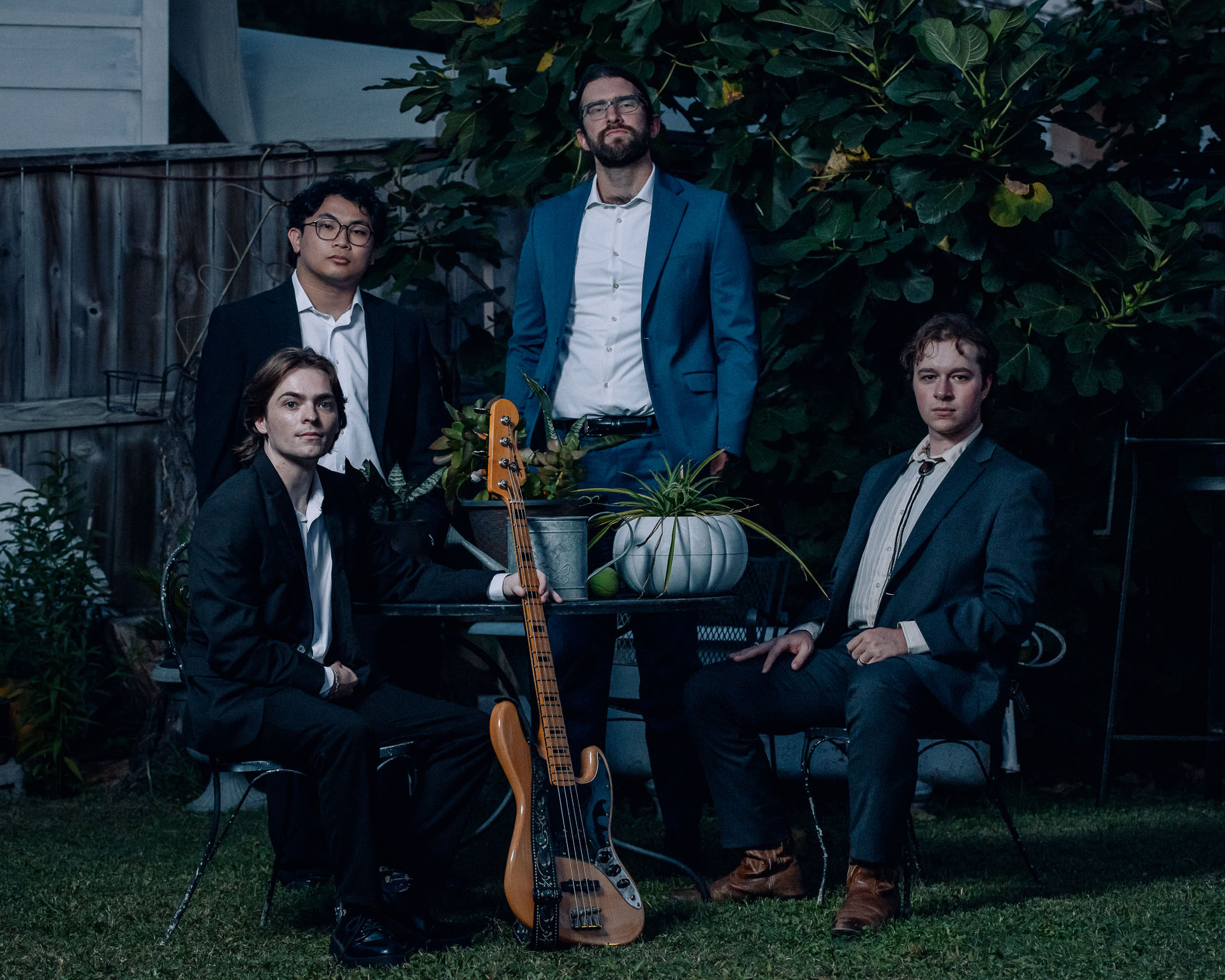
I recently had the pleasure of meeting the four members of April Company. We talked about how they learned to successfully make music with lifelong friends and how they brave the beautiful but brutally hot Houston music scene.
Our conversation below has been edited for brevity and clarity. I hope you enjoy it as much as I did.
The Interview
Diego : We are here with April Company, a group of four fascinating friends. Could you please introduce yourselves and tell us what you do in the band?
Connor Oelsen: My name is Connor Oelsen. I'm the bassist for the band
Zak Pham: My name is Zak Pham. I'm the songwriter, rhythm guitar, and vocals for the band.
Matthew Coronado: My name's Matthew Coronado. I play drums.
Davis: My name's Davis. I am lead guitar, and I complain about the songwriting.
Diego : Let's get started with how you guys founded this band. How did you guys end up meeting each other?
Zak Pham: Back in the day, I used to host local house concerts with a bunch of artists back in the day. We all kind of grew up on the same street, and then we were all in the same friend group. And I just kept trying to make a band. And then me and Davis were just like, "We want to be in a band that's actually good."
Davis: We were just like, "Let's, you know, branch out, do our own thing, kind of stop being like the backing members of other people's bands, and we can have more control over the direction of that."
Zak Pham: This was all high school. And Matt, we actually found like—was it like three years ago?
Matthew Coronado: Three-year anniversary.
Zak Pham: Three-year anniversary. But we had something up on like Bandsintown, like a forum page that we were looking for a drummer, and he just randomly came to our DMs. We were like, "This is perfect."
Connor Oelsen: He's the GOAT.
Diego : And since you guys got together in high school, I believe that your band has had some name changes throughout the years. How did you land on April Company?
Davis: Yeah, I think our first gig we played, we were going under 98% Danger 2% Milk.
Connor Oelsen: I loved that one, honestly. Another good one we vetoed was Forklift Operator. That was Davis's main campaign. I thought that one was pretty funny.
Zak Pham: Anything else? I think we just settled on April. We were in a La Madeleine and we were like, "You know what sounds cool? If we were part of like a company, like a business."
Connor Oelsen: Yeah, we kind of just started ad-libbing things, like "Tuesday Morning." And we were like, "No, that's a store." And then finally we landed on April Company. It's like, "Oh, that'll fly."
Zak Pham: Yeah, and our first show was on 4/20. So that's where the April Company came from, basically.
Diego : Have you guys always had this sort of suit aesthetic as being part of April Company?
Matthew Coronado: Usually we're bums.
Pull up, it was like freaking 90 degrees, pitch black, and we were in a backyard on a bunch of plywood.
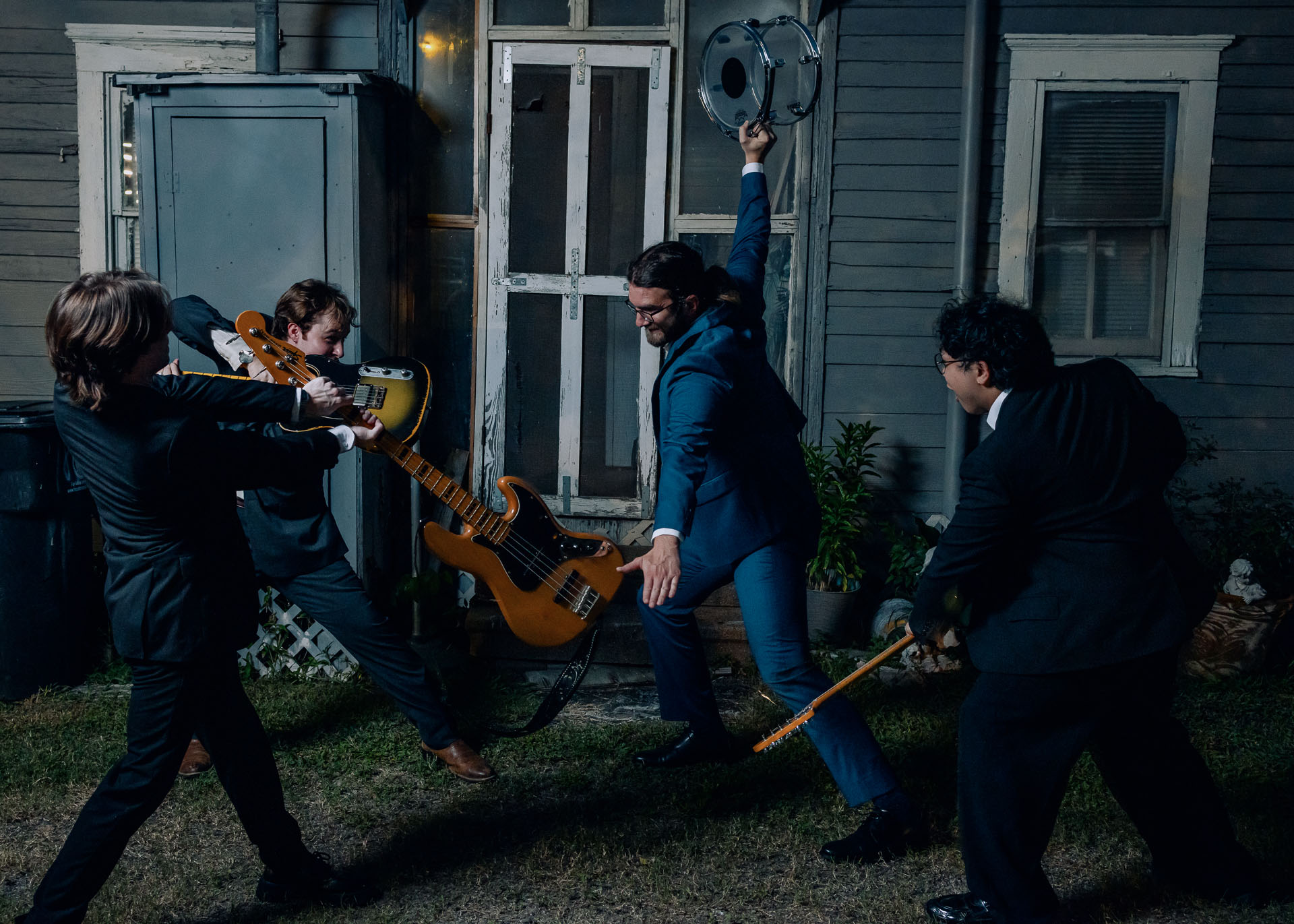
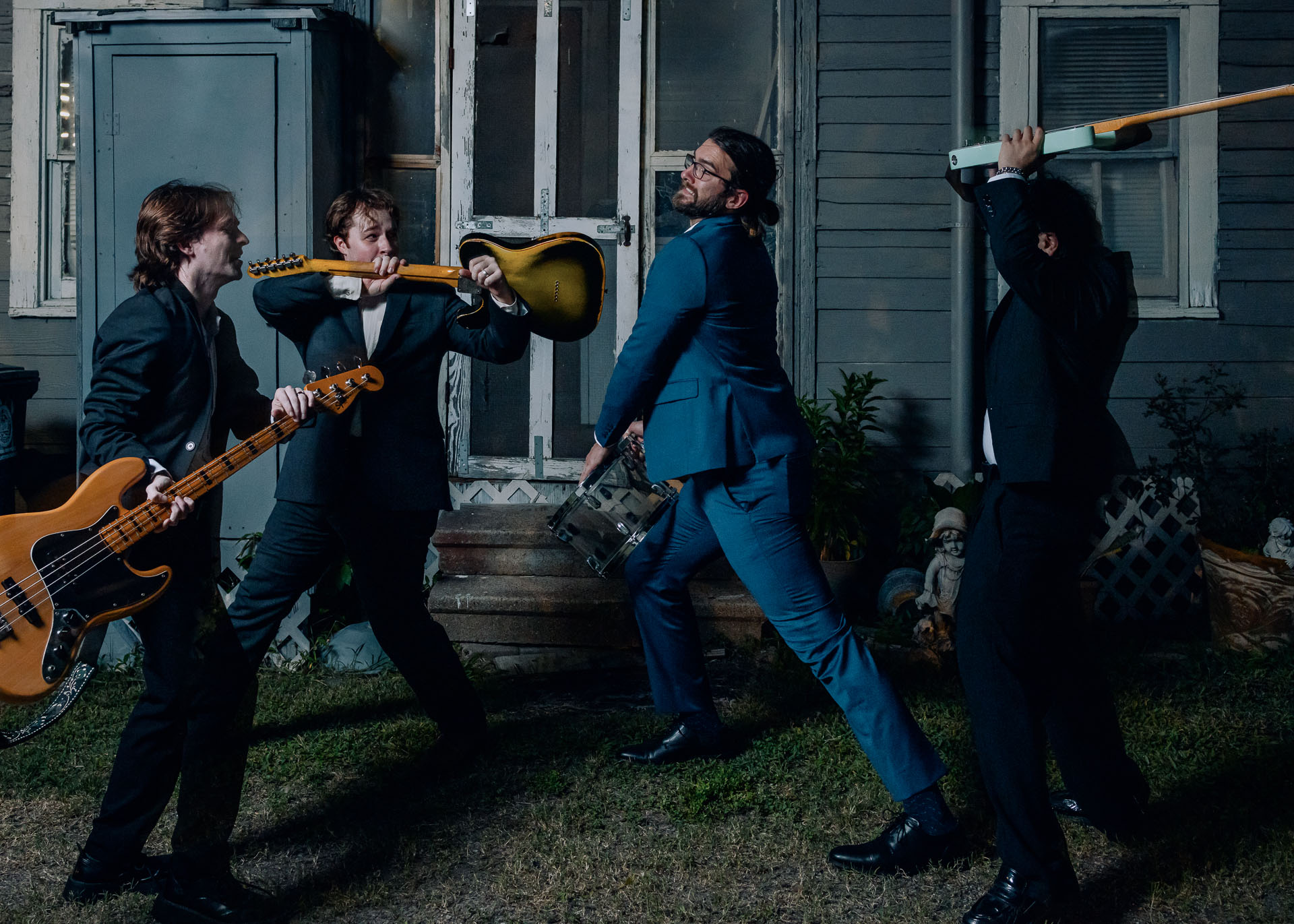
Zak Pham: Yeah, usually we just wear whatever's comfortable. A show day is leisure day. Our first couple of gigs, it was all Hawaiian shirts. And then I think for one gig I was like, "Guys, this is going to be a pretty big gig. We need to wear suits and like dress clothes." Pull up, it was like freaking 90 degrees, pitch black, and we were in a backyard on a bunch of plywood.
Connor Oelsen: Yeah, that was awful. It was like a metal show. Totally didn't fit the theme.
Zak Pham: You stand out.
Connor Oelsen: Yeah, for sure.
Diego : I want to get into the process of how you work together to create your sound. What does that look like for you guys? Where do you guys begin?
Zak Pham: Starting out, it was a lot of spitballing. Like we used to be able to write a song within one day and finish it. That’s how most of our original songs came out. And then we do a bunch of refining. But we had a very fast-track mindset of: we make a song, we record it immediately. Sounds terrible, release it, you know?
Davis: Oh, the SoundCloud days.
Zak Pham: Yeah, the SoundCloud days. But nowadays we spend more than one day on a song because we want to really refine where we're going and have songs of quality that we enjoy, that we can't really be like, "Yeah, this was made on SoundCloud," you know?
Connor Oelsen: Yeah, I'd say Davis and Zak are the main hook writers before starting the idea. It helps that they're both rhythm and lead guitar, you got to start somewhere. Usually an idea is presented and then Matt and I kind of just build around that, and either we like it or we don't. And then we keep kind of swapping things out until it fits.
We show up to practice with a song idea, and Matt will just play something that could totally change the direction of what we thought was going to happen. It's a lot of give and take.
Diego : So would you guys say that you start music first and then get into lyrics?
Zak Pham & Davis: Yes, almost exclusively.
Davis: I will say I think that there isn't a lot of uniformity in the way that we approach writing songs. Recently we've been very like, "You know, we wrote a cool riff, we want to make that work." But historically it's been very like, "Well, let's come up with the chord progression," or "I've got an idea rhythmically that I'd like to incorporate into something." And then we'll bring it to everybody, they'll insert their own knowledge of their instrument into that, and then that will blossom into a song. I don't know anything about drums. We show up to practice with a song idea, and Matt will just play something that could totally change the direction of what we thought was going to happen. It's a lot of give and take.
Zak Pham: 100%.
Diego : Especially with the sort of childhood friendship that you guys have together. That understanding helps the process.
Connor Oelsen: Yeah, I would say it also helps we all kind of started with the same foundation of straight-up emo music, Midwest emo. Like if we're referencing something, we all know where to go off of. A lot of common music knowledge between us as well.
Diego : Yeah, I was going to ask about that as well because it sounds like you guys have a few different influences in your music. I was wondering if maybe we could go around and see where you guys draw inspiration from. Could you share a little bit of where you draw your artistic inspiration from?
Davis: I mean, I think that I come from a jazz background. So that is where a lot of my inspiration lies. You know, I grew up a big Pat Metheny, Wes Montgomery, Grant Green kind of guy. And I think that that has been super beneficial in some ways, and also sometimes I get a little too cerebral with it, and then everybody's like, "Come on, let me back off for a minute." I made that comment kind of facetiously earlier about complaining about Zak's songs; that's where a lot of that comes from. But I think it defines my approach to it, at least.
Matthew Coronado: Man, I grew up listening to a lot of rock and metal and stuff, so metalcore was a big part of my high school days. So I naturally kind of had that aggressive underlying tone to how I like to listen to and approach music. But I mean, over the past decade or so, that's kind of been topped with a little jazz, electronic music. I listen to a lot of house music and stuff like that, so it just depends on the day, you know, where I want to go.
Diego : Yeah, I don’t know if I would characterize your music as very aggressive or very metal, but it's interesting that you come from that space and you can add that extra layer, if you will.
Matthew Coronado: For sure. If anything, I think this music kind of forced me to get out of that mindset and kind of go into waters I wouldn't tread normally, you know, so it's good for getting out of your comfort zone and into new areas.
Zak Pham: I think we all started listening in the same realm of indie bedroom pop, in a way. And as we kind of kept growing up, we just diverged into extremely diverse music tastes. The one thing that's been constant is pop-punk and Midwest emo, for me. A lot of riffs we choose and the direction we've been going recently is because of that.
[As a bassist], I just move around a lot. As far as theory goes, I really only hit the root on the downbeat, and then from there it's free game. I don't know, it's just how I'm feeling that day.
Connor Oelsen: As a bassist, its impossible not to say Thundercat is a big inspiration, because that guy is insane at his instrument. I really liked what he did on Mac Miller's albums. I'm a big fan of Anderson .Paak, all of his earlier Malibu stuff, it's just great. I also have a jazz background, so Mingus, as basic as it is, I mean it's just such a backbone of the instrument that it's good to rely on. And I don't know, I just like being obnoxious. So I write very obnoxious basslines, and I've been trying to find that nice middle ground of groove and melody for the instrument.
Diego : Now, what do you mean when you say “obnoxious bassline”?
Connor Oelsen: I move around a lot. It's very busy, yeah.
Zak Pham: That's the best part of our music, though, I'll say.
Connor Oelsen: Thanks, man. Appreciate that. I just move around a lot. As far as theory goes, I really only hit the root on the downbeat, and then from there it's free game. I don't know, it's just how I'm feeling that day.
Diego : You've got room to roam, then.
Connor Oelsen: Yeah, yeah, yeah.
Diego : Bringing in all these different perspectives, there must be some kind of point where you guys are like, "Okay, we're trying to go for this type of sound or that type of sound," or "What do we add, what do we subtract?" What does it look like for each of you to add your layers to the music?
Davis: It’s a case-by-case basis. Like you said, there are times where we say, "This is what we're going for, and let's figure out how to sort of make that happen," especially with some of our more recent, more distorted Midwest emo-y kind of stuff, where we love that vibe, that feel, and we commit to that. But there are also times somebody will come in with something that they basically wrote on their own, teach it to the band, and then those shifts are very minor as people who maybe know more about their instrument start playing what you wrote.
Connor Oelsen: And then as of recently, in our little practice space that we have, the idea will start and then it's like, "Okay, we really only have 45 seconds of this." And then we just keep kind of adding things that are similar until we end up with something that's five minutes long, and then we end up cutting. So honestly, it's kind of nice because it gives us a chance to play everything that we're kind of thinking in our heads, but then we can make the executive decisions of, "Okay, we don't need this two-minute breakdown at the end of the song."
Zak Pham: We definitely just have a moment where we have to sit down for 10 to 15 minutes to figure out what chord we want in this one spot.
Connor Oelsen: Yeah, that's true. Bouncing back to him being a jazz snob, he'll be like, "Oh, you can do this diminished add whatever here." And then he'll keep playing it underneath, and it takes a couple of tries.
Davis: I'm like, "I just don't like it, though."
Zak Pham: "I just don't think you're playing it right, actually. It's this, this, and this."
Diego : And that's part of the creative process, too, right? Like once you get the ball rolling, you have a bunch of content, then you kind of have to cut back and trim it here and there in order to have what you want.
So I've heard this a couple of times from a couple of different of you guys now: Midwest emo, which is maybe the closest to the sound that you guys are going for. I would say your music evokes feelings of dreamy longing or yearning. Is that what you guys are going for, or what is it that you guys mean when you say Midwest emo? Like what does that mean to you?
And I do think it's funny when we say like, ‘Oh, we make emo music.’ And then we play for people, and the people are like, ‘What do you mean?’
Zak Pham: I think starting out, we've definitely drastically changed our flow of our genre, basically. All of our new stuff that we are writing as of recent has been Midwest emo. I would say the past has been very indie, dreamy bedroom pop.
Connor Oelsen: That being said, a lot of the yearning feeling you probably get is from us listening to a lot of Midwest emo, so it's in our head. While it may not sound like the theme, I mean, it's what we've beaten into our brains for X amount of years.
Zak Pham: We are emo.
Davis: It was not a phase.
Zak Pham: Yeah, it was not a phase.
Connor Oelsen: No, definitely not. It's comforting to say it, at least.
We're the biggest Type B band, for sure.
Zak Pham: And I do think it's funny when we say like, "Oh, we make emo music." And then we play for people, and the people are like, "What do you mean?"
Connor Oelsen: Yeah, a lot of the recent stuff specifically that we're working on, we use Midwest emo more in the term of the guitar lines being very busy and, I don't know how else to explain it, other than riffy, to be point blank.
Diego : It's something that you draw on from a lot and sort of get inspired by, but not necessarily something that you're shooting for very directly.
Connor Oelsen: Yes.
Diego : Okay. And you said that your sound has evolved, right? Like you started more bedroom pop and maybe you're moving closer to that emo. Can we look forward to April Company leaning more into that, are we changing in a different way, or is it kind of up to the future and see what comes of it?
Davis: You know, I don't think that we are looking—at least I'm not looking to...
Zak Pham: Go full-on?
Davis: No, I mean, it's not that I'm opposed to it. It's just like I think whatever we end up feeling like writing is what's worth writing in that moment.
We end up doing shows with metal bands, we end up doing shows with bands that sound like us, we end up doing shows with rappers. Just whatever the scene calls for that night.
Connor Oelsen: Yeah, I feel like a lot of that overlapping music taste that we were talking about earlier, I mean, it kind of applies to the music we write, too, because we can't just settle on one thing. Whenever anyone has an input, it adds a little bit of a different genre to it, whether we like it or not, intentionally or unintentionally.
Zak Pham: We're the biggest Type B band, for sure.
Diego : You need a little bit of flexibility when you have four people. I'm sure that even just the schedules by themselves cause a little bit of a headache. You guys were talking about how you guys just got off of work, right?
Davis: Oh, yeah.
Diego : So you started in high school and have been in Houston ever since. What has your experience with the Houston music scene been like for you guys? So what has that journey been like for you guys?
Zak Pham: Terrible!
Diego : All right, we can end right there! Thank you guys!
Connor Oelsen: No, I mean, there's a lot of great things about the music scene in Houston. It's just a lot happens on the same night. Obviously, it's a huge city, but I don't know if you're familiar—I forgot the name of the Instagram account, but it would just post all the local shows going on in Houston.
Zak Pham: There's Houston Underground, there's Houston Music Classifieds.
Wherever you go in Houston, you're going to see a show. You don't know what genre it's going to be, who's going to be there, but somehow you'll see everyone you've known your entire career in that one space. It's amazing. I love it here.
Connor Oelsen: Yeah, so during the summertime I would look at that just to see if our band's listed. And then there's 35 shows going on. Everywhere you go, you're going to find some different genre, different musician. It's not like the scene has a genre, which is awesome for us considering we were just talking about having no real genre. We end up doing shows with metal bands, we end up doing shows with bands that sound like us, we end up doing shows with rappers. Just whatever the scene calls for that night.
Zak Pham: I think that's the best part of the Houston music community: it's so big, but at the same time it feels like everyone's interconnected.
Connor Oelsen: That's true. There's a lot of, "Oh, we've played with them before," or "Oh, I've heard that our friends have played with them before," that kind of thing.
Zak Pham: Yeah, so there's an intersectionality of different genres. Wherever you go in Houston, you're going to see a show. You don't know what genre it's going to be, who's going to be there, but somehow you'll see everyone you've known your entire career in that one space. It's amazing. I love it here.
Connor Oelsen: Honestly, I think some of our success has to do with just talking to people. I'm going to be honest, I'm not much of a talker in the band. But that being said, just like...
Diego : You're the shy one?
Connor Oelsen: Yeah, believe it or not! Even if it's not the most acclaimed venue, people are still there to listen to music and see a show. So whatever little impact—or if you feel like you're not really getting anywhere—it still means something to someone, and even if it doesn't, you still tried. We've done park gigs, we've done house gigs, and then as people started to know our name, it kind of opened doors for us to like, "Oh yeah, we've heard this band April Company, they're good, you should have them on this bill," or things of that sort.
Zak Pham: Like Connor said, it was kind of a reliance on the community and trusting the process. A lot of just throwing stuff at the wall and seeing what sticks. And we started from recording in our bedroom to still recording in our bedroom, but then now we go to a studio.
I enjoy the energy that comes off the people, and while I may not move a lot to show that, it's still nice.
Connor Oelsen: Yeah, I will say the main grind, so to speak, is equipment. But even then, I've done shows where I'm using a $50 Rumble amp and an old Ibanez bass I've had for 10 years. You just got to make do with what you got as well.
Diego : And if you've got the skill, then it's going to sound good either way.
Connor Oelsen: You know, it's got that natural distortion.
Diego : That's where you get a little bit of that metal sound. Got to blend in with Matt. I'm curious, what has been your favorite memory or your fondest memory of having been in the Houston music scene? Looking back, maybe your favorite memory or your most proud memory where you feel like, "Wow, okay, this is real"?
Davis: That's a thinker. There are a ton of examples of little things. I remember the first time I heard a crowd singing our songs back to us. I think we were playing at House of J. Is that still around?
Zak Pham: Yeah, still around.
Davis: Okay, I thought maybe it closed down.
Connor Oelsen: Well, they did renovations. There was a Cali band that came through a couple of years ago, and apparently it broke the floor.
Davis: Yeah, they collapsed the floor of the house itself.
Diego : That's how you know it's a good show.
Davis: No, but that was obviously a very moving moment. That was the first time I was like, "Oh man, people like our music. We're not just some band that's at the gig because they needed to fill time, right?"
Even if it's a room full of five or ten people, just having one person connect with your music, it's hard to put into words, you know? It just makes you feel like you're in the right place at the right time.
Connor Oelsen: There was this one show specifically, we were playing Axelrad's upstairs room. And admittedly, free drinks for the band!
Davis: Oh my god. Why else do we do music, you know?
Connor Oelsen: It was one of those gigs where it didn't even feel like... I don't want to say it didn't feel like I was putting effort in, but it was effortless. There wasn't much that I was worried about, and then next thing I knew the set was over. But I just remember the ambiance of the room, it was very happy—which is kind of corny, but just seeing people smile and dance to our music, that's what it's about, low-key.
Diego : Sounds like you were enjoying a bit of a flow state.
Connor Oelsen: It's one of those, but that goes for whatever shows we play. I enjoy the energy that comes off the people, and while I may not move a lot to show that, it's still nice.
Diego : You got to keep your reputation as a bassist, right?
Connor Oelsen: Yeah, as a bassist, you're allowed that one little square!
Davis: I remember my guitar was wet after that one.
Connor Oelsen: Yeah, dude, it was super—I don't want to say dingy, but it was just humid. A fun show.
Davis: I like the breathability of their outside stage.
Connor Oelsen: That's true. Outside venues in Houston are awesome because as long as the sun's not on you, it's like, okay, I can breathe. Air conditioning, no matter how good it is, it'll never keep up with that amount of people.
There have been many moments where our guitars have exploded on stage, broken down, strings breaking like seven times. But we always have friends in the community or people who are willing to lend their guitar.
Diego : Matthew, do you have a favorite memory?
Matthew Coronado: I can't pinpoint one, but what comes to mind is just how rewarding it is to have someone come up to you after the show and just say, "Hey, I really liked that lick you played," or "That song really means a lot to me," or "I felt sad and it meant something to me." Even if it's a room full of five or ten people, just having one person connect with your music, it's hard to put into words, you know? It just makes you feel like you're in the right place at the right time. So that's probably the most rewarding.
Diego : I love that. That's sweet. Zak, you’re nodding your head. You concur?
Zak Pham: Oh, I do concur! Fully concur! There have been many moments where our guitars have exploded on stage, broken down, strings breaking like seven times. But we always have friends in the community or people who are willing to lend their guitar.
That same show you're talking about, actually, my guitar broke half of its strings, so I had to use the Boza Boys' guitar. It was no drums, actually just three of us, playing to a room full of people. And we were just freaking doing it, and they were singing back at us, so sweaty. And I did not know a crowd could get so hyped over just a bunch of guitars playing with no drums!
Connor Oelsen: That did feel pretty rewarding. No wonder I brought up that night.
Diego : Great! Soit's been lovely to have you guys, but before we go, I want to give you a chance to shout out anything coming up for you guys—any future plans, any projects that you guys have, any shows coming up. What's next for April Company?
Zak Pham: We are working on a short EP coming out, basically kind of a rehash of all our old originals, re-recorded in the studio. And then I would say the next one would be ideally with the new stuff, an EP or LP.
Connor Oelsen: Yeah, we're still waiting to get picked up by HBO for our miniseries, The Company. Six seasons and a movie.
Zak Pham: Yeah, or our Netflix documentary on how the band broke up.
Connor Oelsen: It's funny because when we started, I swear it was like every other year a fan would be like, "So when's the album coming out?" "Don't worry, it's in the works, right around the corner!" Hey, how long have we been a band? Probably six or seven years.
Davis: Four of those years Zak and I were living in Austin. It was like a borderline hiatus, except for we recorded Infinite Cup Glitch in a room up there.
Connor Oelsen: That was the most non-hiatus hiatus.
Zak Pham: But now we are focused on making actual projects. We also have another EP coming out after that of all of our new material we've been working on.
Diego : Any names that you want to preview here?
Davis: I've been thinking about bringing back 98% Danger 2% Milk. We'll see if that flies.
Connor Oelsen: One that's in the works that may or may not stick is Griff's Irish Pub.
Davis: We need to check to make sure. It's a bar that I live near and like to go to. Chill spot. I'll plug Griff's Irish Pub! It burned down, now it's back.
Matthew Coronado: Like a phoenix.
Davis: Like a phoenix rising from the ashes. What a beautiful sentiment.
Zak Pham: That's the album name: "Like a Phoenix Rising Through the Ashes." That's the most cliché...
Connor Oelsen: ...April Company.
Diego : And that feels like a great moment to sign off. Thank you very much, April Company. It was amazing talking to you guys, and I look forward to seeing what you guys do in the future.
April Company: Thank you so much. This was awesome.
I recently had the pleasure of meeting the four members of April Company. We talked about how they learned to successfully make music with lifelong friends and how they brave the beautiful but brutally hot Houston music scene.
Equal parts cinematic storyteller and unfiltered hometown talent, Houston MC Nick B opens up about balancing raw vulnerability, stage-shaking energy, and unshakeable authenticity.